Urban Cycling and Design: Perspectives from Urban Designers and Practitioners
05.27.26
- Culture
- Design
Two wheels, two cents on urban mobility from the designers who move the city.
For National Bike Month, we decided to take a closer look at how cycling shows up across our Texas studios and what it reveals about the places we live and design in.
Within TBG’s Austin studio, the presence of active transit is impossible to miss. Commuting on two wheels isn’t an occasional weekend hobby; it was a daily lifestyle statement. Come Texas heat, freezing winter mornings, or sudden autumn downpours, a dedicated crew roll in fully committed. This consistency prompted more questions: Why here? What transforms a street from a hostile concrete channel into an inviting multimodal corridor?
To better understand that relationship, we conducted a quick cross-office survey to map our firm’s cycling habits, lived experiences, and notable design benchmarks. In Houston, the numbers were quiet. In Dallas, a handful of riders. In San Antonio, mostly recreational. But in Austin, there was a robust, thriving biking cohort. This regional disparity quickly reveals a fundamental truth: biking is not merely an individual physical choice. It is a direct reflection of local infrastructure, urban canopy, and spatial typography. Biking fails to catch on in areas where planning fails to support it.
In Practice
Designing for Micro-Scales and Microclimates
To understand this dynamic, we sat down with Ryan Blair from our firmwide Urban Design + Planning team. He pointed out that bike-friendly cities don’t happen by accident; they are systemic networks designed from the ground up.
“In high-performing communities, the design focuses on micro-connections,” Ryan explains. “For instance, safe routes are intentionally plotted to connect neighborhoods directly to local primary schools and parks. The design doesn’t rely on flashy, complex infrastructure. It relies on establishing parental trust and psychological safety.”
Striking a painted stencil on a high-speed arterial roadway is not the same as shaping a physical environment where active transit is treated as a default choice. “If the bike racks outside are full,” Ryan notes, “it’s structural proof that the surrounding urban fabric is working as intended.”
This philosophy is on display at Hometown in North Richland Hills, where master planning successfully integrated community pathways. A centrally located elementary school sits within an intuitive five-minute ride for most residents, and under ten minutes for the entire master-planned development. Slow residential streets, paired with off-street, shared-use trails, prove that intuitive design builds community trust.
Lived Experiences
The Geometry of Comfort: What Riders Need
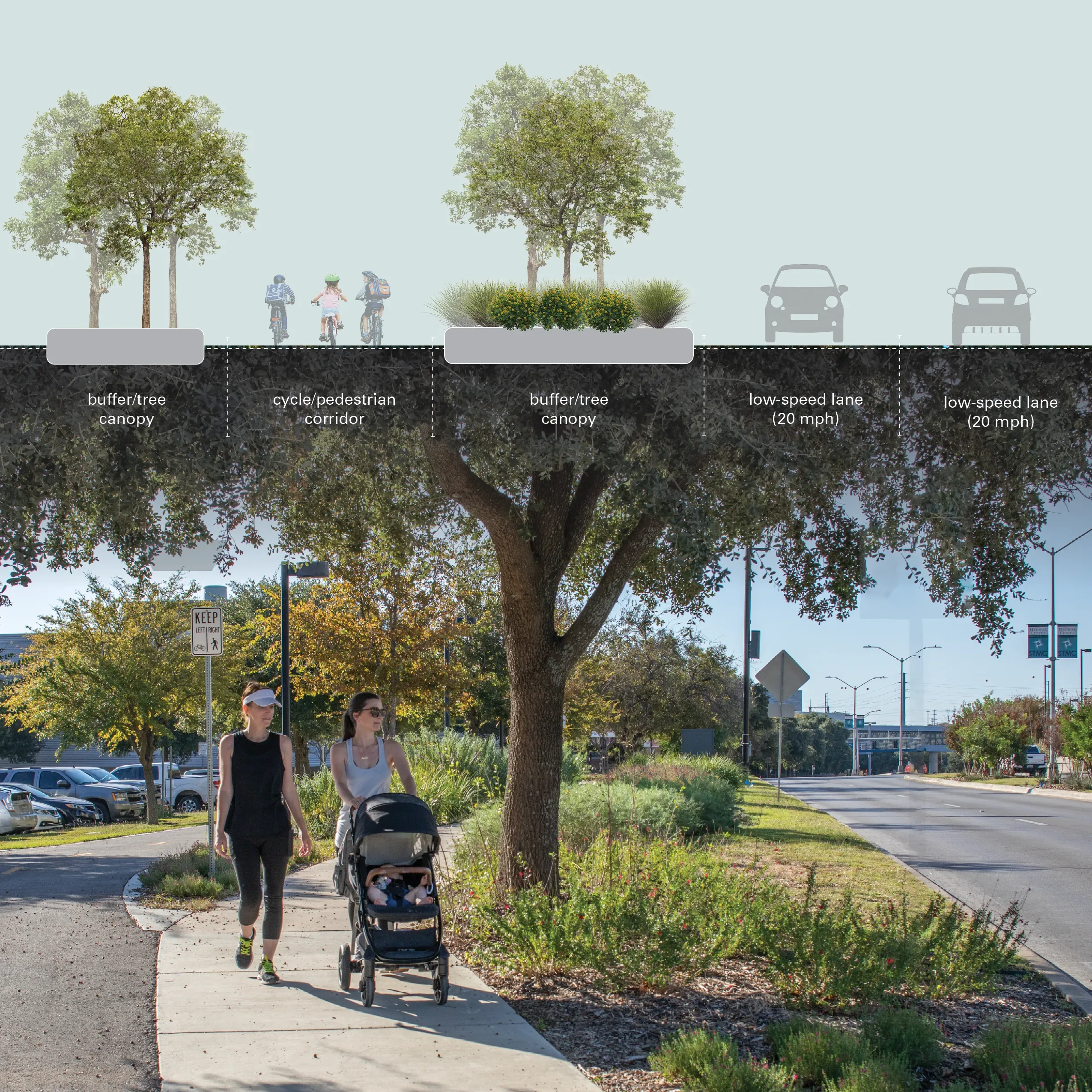
We reached out to several of our inner-office riders, asking what makes their daily commutes accessible. Their joking response, “shade, wide protected tracks, and zero cars,” actually points to the foundational elements of physical and spatial safety.
The reality of cycling comfort depends entirely on physical details. Elements like urban canopy shade, street cross-section design, intersection conflict points, and speed limits aren’t just details on a CAD sheet; they determine whether a ride feels routine or risky
When asked where they have experienced active transit executed flawlessly, our team pointed to international benchmarks. Jordan Clark, Director of Performance in our Dallas studio, highlights the Netherlands as a premier model of multimodal efficiency.
“Their planning approach is anchored in what they call Sustainable Safety,” Jordan says. “It assumes that humans will naturally make mistakes, and then designs street geometry so those mistakes aren’t catastrophic. Right now in most American cities, you can technically bike anywhere, but you must be prepared for dangerous, high-impact interactions. It shouldn’t be that way. Safety must be an inherent right, not a localized luxury.”


Active Commutes as Site Analysis
For design practitioners, the bike ride itself is a valuable form of site analysis and spatial observation.
Nik Braun, Technical Design Specialist in our Austin office, experienced this firsthand while living in Erfurt, Germany. The city offered micro-subsidies for residents to purchase cargo bikes, leading to widespread adoption within two years.
“For us as designers, active mobility is a way of understanding and analyzing neighborhoods,” Nik shares. “Traveling on foot or by bike completely changes your spatial scale. You can pause anywhere, take note of fine-grade paving details, observe planting transitions, and study how people interact with public spaces. It’s the ultimate method for site immersion.”


Active environments also act as a natural social catalyst. “When you’re riding a bike, you are completely face-to-face with your community,” notes Elliot Williams, Landscape Designer in Dallas. “You aren’t shielded behind glass and steel. You make eye contact, wave, and experience the local streetscape on a human scale.”

Dismantling Motonormativity
Many of these conversations continually hovered around a broader term popularized by environmental psychologists: motonormativity. This concept describes the pervasive social habit of treating car-centric layouts as natural, while viewing any active alternative as an inconvenience. Once you recognize this layout bias, it becomes impossible to ignore how much of our public realm is optimized for speed and parking rather than the quality of human life.
In Austin, Urban Designer and Planner Luiza Mola Curi notes how the rise of e-bikes is starting to challenge these old assumptions. City programs also help make that shift more attainable. Austin Energy’s E-Ride Rebate is one example, lowering the barrier for residents who want to replace car trips with a bike that can handle distance, heat, and daily errands.
“E-mobility is democratizing who can bike and how far they can go,” Luiza says. “It restores a sense of agency and freedom over how we traverse the city. But sharing the public right-of-way still requires a cultural shift in patience and mutual respect.”


In contrast, our team in Houston works within a landscape shaped by immense highway architecture. Grant Huber, Landscape Designer in Houston, observes the unique challenges of coastal cities.
“Houston actually features beautiful, high-performing greenway systems along our bayous,” Grant says. “However, once you leave those corridors, the gaps between networks can feel disjointed. Yet, the community of active commuters here is exceptionally loyal. If our landscape designs provide them with secure, connected pocket nodes, they will show up.”


Looking Forward
If we want to design inclusive regional communities, we must design spaces that welcome all modes of human movement. Programs like San Antonio’s, annual Síclovía temporarily reclaim vehicle corridors for pedestrians and micro-transit, allowing residents to experience familiar streets in entirely different ways. In Austin, organizations like Movability help advance that same work year-round by convening partners, advocating for safer streets, and supporting policies and projects that make it easier to choose biking, walking, and transit year-round.
Not every urban resident is going to bike to work in the summer heat, and that is perfectly okay. But the more we as landscape architects, designers, and planners prioritize continuous comfort, safe street geometry, and shading canopies, the more our communities become spaces designed for everyone.
Because safe, active routes shouldn’t just be for the exceptionally brave. They should belong to us all.