Designing with a Finite Resource: Water
07.21.26
- Environment
In Texas, “Where did you come from, where did you go?” is more than a familiar refrain. It’s also the question we should be asking about every drop of water moving through our cities.
Water is the foundation of every Texas community, landscape, and economy. Yet the state still treats too much rainwater as something to move away as quickly as possible, rather than a precious resource to capture, clean, and reuse. As population growth, drought, and extreme rainfall continue to strain our systems, responsible design has to do more than conserve water at the margins; it has to rethink how every project collects, stores, and returns water.
Holistic stormwater management is one of the most practical ways to do that. TBG designs landscapes to reduce runoff volume, improve water quality, and prioritize infiltration. These three goals are interconnected; we cannot achieve one without the others.
By capturing rainfall where it falls, projects have more opportunity to do the following:
_ increase available water supply
_ reduce localized flooding
_ lessen the demand for grey infrastructure
_ improve water quality
_ reduce treatment needs
_ support groundwater recharge where appropriate
_ lower long-term operating costs
Instead of allowing stormwater to become runoff, thoughtful design puts it to work.


Just months after construction, Hurricane Harvey put the system at Riverstone Wetland Park to the test. A series of interconnected ponds temporarily filled beyond their normal levels, but the water didn’t exceed the banks due to the system being set up to overflow into pipes that discharge into the main lake system. It remained in a state of inundation for several weeks, but once the waters receded, other than expected mud and muck on the bridges and trails, the plants immediately bounced back, ultimately doing its job functionally as a wetland while offering peace of mind to residents. The project also demonstrates how water can become more than infrastructure. The project transformed 4.5 acres of underutilized land into a native wetland ecosystem that creates habitat and connects people with nature. Today, the park supports birds, pollinators, fish, and wildlife, attracting 202 bird species and becoming one of Fort Bend County’s premier birding destinations despite its relatively modest size.


You don’t normally expect to learn about the true potential of blackwater on your way to getting a permit. That’s now likely to happen to attentive visitors to Austin’s new Permitting and Development Center (PDC). And it’s exactly what the city wants—developers confronting face-to-face, the remarkable, cost-effective potential of water reuse technology. The City of Austin’s Permitting and Development plants the flag for Texas’ first demonstration blackwater reclamation system.


The City of Pflugerville Old Town Park Master Plan reimagines the city’s historic water tower into a vibrant, community-centered park that reflects the city’s deep history. The design draws inspiration from Pflugerville’s water lifecycle, tracing its path from the Colorado River to Lake Pflugerville, through the local pump station, and up into the historic water tower before ultimately returning to the site through rain gardens. This cycle of movement, delivery, and reclamation serves as a guiding framework for the park’s vision and design
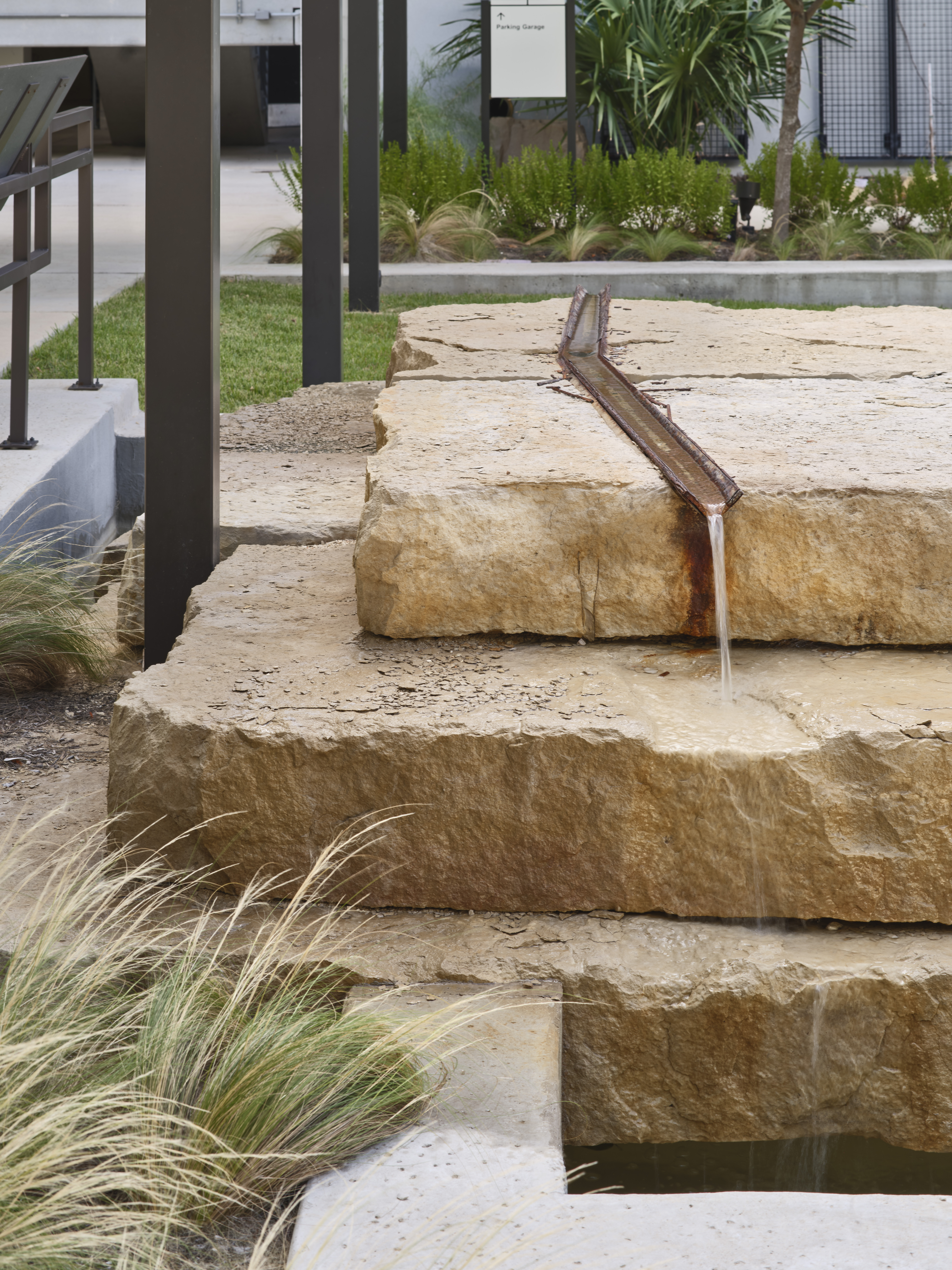
Beyond performance, these project strategies also make water visible and emphasize experiential learning by making water engaging. When visitors can see cisterns, rain gardens, recirculating fountains, small waterfalls or runoff being redirected into planting areas, they begin to understand that water does not simply appear from a tap or disappear into a drain. Design can turn everyday landscapes into public lessons about scarcity, stewardship, and shared responsibility.
TBG’s approach to long-term sustainable impact is not abstract, nor is it an optional “add-on.” It is rooted in a shared ethic of care taking—we believe that every project is a contract with the landscape and the range of life it supports. This philosophy applies regardless of client, budget, or zip code.